
How to Improve Sleep Apnea: Tips for Better Sleep
Waking up tired after what should have been a full night of sleep can be incredibly frustrating. You may go to bed for eight hours,
Updated On
Table of contents
You start climbing a flight of stairs and suddenly feel breathless, you feel your chest tightening, and your heart racing. Each step leaves you panting, and even a short climb feels exhausting. Feeling breathless after climbing stairs can be unsettling, and you might find yourself wondering if this is normal or a sign of something serious.
Many people assume it’s just being out of shape or part of getting older, but frequent panting or sudden breathlessness shouldn’t be ignored. Understanding why it happens is the first step to taking control of your health.
While exercise capacity is definitely a component, being short of breath after climbing stairs can often be a critical symptom of something far more insidious. Often, it’s the very first clue that your airway isn’t doing its job properly, which all comes down to your anatomy in the TMJ & jaw, tongue, and throat region.
In this blog, we’ll explore what causes shortness of breath when climbing stairs, how to prevent it, and when to seek medical advice.
Shortness of breath after climbing stairs can happen for many reasons. For some, it occurs occasionally, while for others, even a few steps can leave them winded. Understanding the causes helps you address the problem rather than just managing the symptoms.
Identifying the reasons behind your breathlessness is the first step to improving your stamina and overall health. Once you understand the triggers, you can take targeted steps to prevent it.
Next, let’s look at the risk factors that make certain people more prone to feeling breathless after walking up stairs.
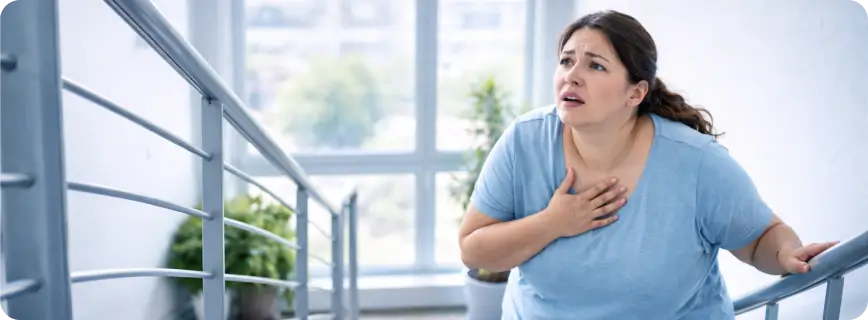
The more active you are, the more oxygen your body needs. Your respiratory system must function well enough that it does not require a “fight or flight” response when you climb up a simple staircase. When you become easily out of breath when climbing stairs, then you have an airway problem that cannot meet the basic requirement.
In our practice as an airway dentist, we have come across many cases where the individual is physically fit – they could be marathon runners, cyclists, or mountain hikers. The reason being that your heart may be healthy but if your “air intake pipe” is clogged, then you will always be running on low efficiency.
Feeling breathless after climbing stairs isn’t the same for everyone. Some can breeze up a few flights, while others are panting after just a few steps. Knowing what makes you prone to this kind of breathlessness is the first step to taking control of your health.
Even if you are generally healthy, overexertion can leave you breathless. Recognizing these risk factors earlier lets you make small changes before the problem becomes serious.
Next, let’s explore practical ways to prevent feeling out of breath after walking up stairs.

Practical ways to prevent breathlessness:
Lifestyle changes that support better breathing:
When followed regularly, these lifestyle changes can noticeably reduce episodes of feeling out of breath after walking up stairs. However, if symptoms persist or worsen, it is important not to ignore them and seek medical advice.
Occasional breathlessness can happen, especially if you are not very active. But frequent or intense episodes should not be ignored. You should consider seeing a doctor if you notice any of the following:
Early medical attention can prevent complications and help you manage shortness of breath after climbing stairs more effectively
Feeling breathless after climbing stairs is not something you should simply brush aside. Sometimes it reflects low stamina, but other times it may mean an underlying issue that needs attention. Paying attention to the pattern, understanding the causes, and improving daily habits can truly change how your body responds to exertion. With the right steps, many people notice that climbing stairs becomes easier without panting or being breathless.
If breathlessness is frequent or worrying, it’s wise to seek expert care. The Right Bite Sleep and TMJ Pain Care can help you uncover the root cause and guide you with the right treatment. Get professional support now and prevent bigger problems later, contact us today.
Contact us
Our other blogs
How to Improve Sleep Apnea: Tips for Better Sleep
Waking up tired after what should have been a full night of sleep can be incredibly frustrating. You may go to bed for eight hours,
Snoring and Dry Mouth: Causes, Connection and When to Seek Help
You wake up with a parched mouth, a sore throat and the feeling that your sleep did not do much good. Your partner, meanwhile, may
How to Improve Sleep: Simple Tips to Sleep Better and Wake Up Refreshed
You can spend eight hours in bed and still wake up feeling like you have barely slept. Your alarm rings, you hit snooze, then finally
WhatsApp us