

Maxillary expansion is a procedure that gently widens the upper jaw (maxilla) to correct a narrow palate and create more space for the teeth.
Published on
Table of contents
Clear aligners are an increasingly common orthodontic treatment for people who wish to straighten their teeth without conventional metal brackets and wires. They are removable trays that are custom made to gradually shift teeth according to an orthodontic treatment plan.
So, if patients understand what are aligners for teeth, the benefits, different tooth aligners uses and the purpose of an attachment for aligners, then they can understand what to expect before starting a treatment.
Aligners are a set of personalized clear orthodontic trays designed to gently move teeth into their planned positions. With the advancement of 3D imaging technology, these orthodontic trays are fabricated to apply gentle, targeted pressure which shifts your teeth into their ideal positions over time.
Unlike conventional method (brackets and wires), aligners use a series of removable trays. Each aligner is usually worn for approximately 20–22 hours per day, depending on the orthodontist’s treatment plan and each set of aligners is slightly different from the previous one. Treatment is planned in analigner software which allows the orthodontist to evaluate the movement of individual teeth and create a customized treatment plan.
Unlike a single removable appliance, clear-aligner treatment usually involves a sequence of trays. Each tray is designed to contribute to specific planned tooth movements before the patient progresses to the next stage.
Professional assessment remains important because clear aligners are not suitable for every type or severity of malocclusion. The American Association of Orthodontists also notes that some, but not all, orthodontic problems can be successfully treated with clear aligners
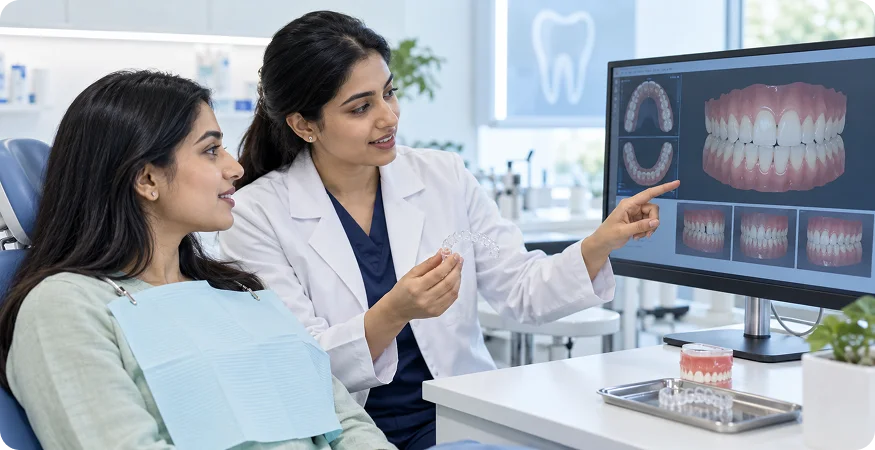
Tooth movement occurs when light, controlled orthodontic forces are applied to the teeth.
During aligner treatment:
The number of aligners which is fabricated varies from person to person depending on the severity of the case.
Digital treatment planning allows the orthodontist to plan the direction and sequence of tooth movement. Regular monitoring is still important because actual tooth movement may differ from the predicted digital simulation.
One of the most common questions patients ask concerns tooth aligners uses. Clear aligners can be used for several orthodontic problems, but treatment suitability depends on the complexity of the bite and the movements required.
Clear aligners treat various types of orthodontic issues which includes:
When there is a little space in the dental arch, teeth may overlap or rotates. Aligners help to improve the alignment of crooked teeth.
Aligners can close gaps between teeth by slowly moving the teeth toward their desired positions.
In few cases, aligners help to correct excessive vertical overlap of the upper front teeth over the lower teeth.
Depending on the cause and severity, aligners may be used to correct some dental crossbites.
Aligners can be designed to rotate teeth into a more appropriate position. However, some difficult rotations may require additional orthodontic techniques.
People who previously undergone orthodontic treatment may feel some sort of tooth movement after treatment.
Notes-These Aligners are not suitable for every orthodontics case, these can vary depending upon bite, bone support, overall treatment objective and the complexity of malocclusion which will be evaluated by orthodontist.
This evaluation is particularly important when significant bite correction, complex tooth movement or other orthodontic procedures may be required.
Clear aligners offer various advantages compared with conventional braces.
Because aligners can be removed, patients can generally brush and floss without having to clean around fixed brackets and wires. However, this removability also means treatment success depends heavily on patient compliance with the recommended daily wear schedule.
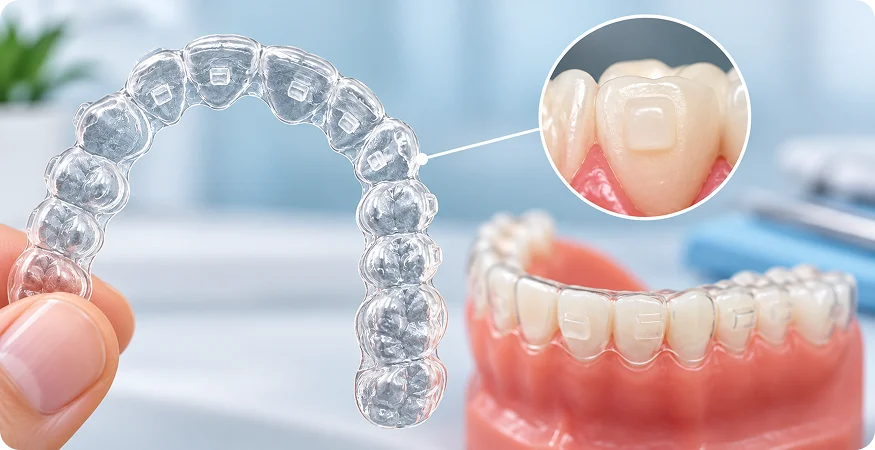
Aligner attachments are small, tooth-coloured or composite shapes that are bonded to the patient’s teeth to help achieve the movements previously planned on the software. It can produce many types of tooth movement on their own, certain movements require additional retention and force control. Attachments assist the aligner grasp the tooth and apply forces more effectively. These aligner fits over attachments, allows to engage with the tooth more efficiently.
Consider the attachment as a small “handle” that gives the aligner a better surface to push, pull, rotate, or control a tooth.
Not all patient needs attachments. Their number, shape, size, and location are determined according to the individual treatment plan.
These attachments are used temporarily and at the end of treatment orthodontist removes these attachments and polishes the tooth surface to restore the original appearance.
An attachment for aligners assists the tray in better engaging a specific tooth when additional control is required. Attachments may be used to aid movement such as rotation, extrusion, intrusion, or controlled movement of the root and crown depending on the treatment plan.
They are usually the color of teeth so are much less noticeable than traditional metal brackets. but they can make the aligner a little more visible where attachments are present.
The American Association of Orthodontists describes attachments as tooth-coloured bumps placed on teeth during clear-aligner treatment to help move them, after which they are removed once treatment is completed.
No. Some patients may need several attachments, while others may require only a few or sometimes none.
The decision depends on factors such as:
Attachments should therefore be viewed as part of customized treatment planning rather than an indication that treatment has become more complicated.
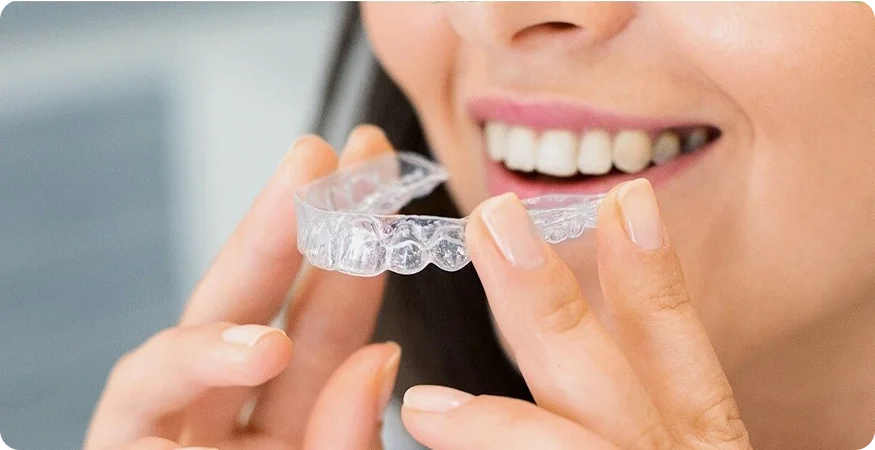
For a successful and faster treatment, aligners need to be worn for around 20–22 hours per day, unless your orthodontist recommends otherwise.
They are removed only for eating, drinking anything other than water, and while brushing.
Consistency is essential because leaving aligners out for extended periods may interfere with the planned tooth movement and may affect how well subsequent trays fit.
Patients should follow the wear schedule and tray-change instructions provided by their orthodontist rather than changing aligners earlier on their own.
Clear aligners can correct a lot of orthodontic problems but aren’t necessarily the best option for all patients automatically.
An orthodontist may evaluate: Before recommending treatment an orthodontist may evaluate:
Professional supervision also enables monitoring and adjustment of the treatment progress when the tooth movement does not quite proceed according to the initial plan.
Understanding the treatment journey can make the process feel much less complicated.
Initial Consultation
Your orthodontist examines your teeth and bite to determine whether clear aligners are appropriate for your needs. Digital scans, photographs, X-rays, or dental impressions may be used depending on your situation.
Treatment Planning
Your provider develops a customized treatment plan showing how your teeth are expected to move throughout treatment. The number of aligners required depends on the complexity of your case and the planned movements.
Receiving Your Aligners
Once your aligners are ready, your provider will explain how to insert, remove, clean, and care for them. If attachments are part of your treatment, they may be placed during this stage.
Wearing Your Aligners
You will generally need to wear the aligners for most of the day and night, removing them primarily for meals, drinking beverages other than water, and oral hygiene. Your orthodontist will provide specific instructions for your treatment.
Regular Checkups
Your orthodontist will monitor your progress during scheduled appointments and determine whether your teeth are moving as expected.
Retainers After Treatment
Your orthodontic journey does not necessarily end when you finish your final aligner. Teeth can naturally shift over time, which is why retainers are commonly recommended after orthodontic treatment.
The purpose of a retainer is to help maintain the new positions of your teeth.
Both clear aligners and traditional braces are designed to improve tooth alignment, but they use different approaches.
| Feature | Clear Aligners | Traditional Braces |
|---|---|---|
| Appearance | Transparent and discreet | More visible |
| Removable | Yes | No |
| Eating | Remove before meals | Certain foods may need to be avoided |
| Oral hygiene | Trays can be removed for brushing | Cleaning around brackets requires extra care |
| Attachments/brackets | Attachments may be required | Brackets and wires are used |
| Suitability | Depends on the orthodontic case | Can be used for a wide range of cases |
There is no single treatment that is right for everyone. The appropriate option depends on your orthodontic needs, treatment goals, and the complexity of the movements required.
With the use of customized transparent trays, aligners are a contemporary orthodontic treatment technique that slowly move teeth into desirable positions.
Aligners can treat various conditions like crowding, spacing, rotations, certain bite problems, and orthodontic relapse. Many patients find this as an appealing options due to ease of removing, invisibility and maintaining oral hygiene.
Aligner attachments help to grip the individual teeth and to achieve more controlled movement.
However, accurate diagnosis, treatment planning and compliance are important for effectiveness of aligner therapy, so before determining aligners are better options it is better to consult orthodontist first.
Consult The right Bite and The TMJ Care today to find out if aligners are the right fit for your smile goals!
Contact us
Our other blogs
Maxillary expansion is a procedure that gently widens the upper jaw (maxilla) to correct a narrow palate and create more space for the teeth.

Can Gums Grow Back After Receding? Causes and Treatment Options
Gum recession is common, and it’s easy to miss early on. Some people notice their teeth look a little longer than they used to. Others
Can Teeth Grinding Cause Tension Headaches? Causes & Symptoms
You wake up with a dull headache, a tight jaw, and a strange feeling that your face has been working all night. You take a
WhatsApp us