
Snoring and Dry Mouth: Causes, Connection and When to Seek Help
You wake up with a parched mouth, a sore throat and the feeling that your sleep did not do much good. Your partner, meanwhile, may
Published on
Waking up with a stiff, sore or restricted jaw can make even simple morning activities, such as drinking water, speaking or eating breakfast, uncomfortable. You may experience difficulty opening your mouth fully, tenderness while chewing, or a dull ache extending towards the temples, ears or surrounding facial muscles.
Although occasional jaw stiffness may be temporary, recurrent symptoms should not be overlooked. Persistent morning jaw discomfort can be associated with nighttime teeth grinding or clenching, muscle tension, or temporomandibular disorders (TMDs), a group of conditions affecting the jaw joints and the muscles responsible for jaw movement
The problem is more common than many people realize. A recent global meta-analysis estimated the prevalence of sleep bruxism at about 23%, although estimates vary considerably depending on how the condition is measured. Another systematic review found that possible awake bruxism affects roughly 16% to 32% of people.
So, what is actually happening while you sleep, and when should morning jaw stiffness be taken seriously?
Jaw tightness is far more than a minor morning inconvenience, it is a widespread oral and musculoskeletal health issue. Global health data indicates that over 21% of the population experiences sleep bruxism (unconscious night-time teeth grinding and jaw clenching).
Furthermore, research reveals that up to 30% of adults suffer from Temporomandibular Joint Disorders (TMD/TMJ), making it the second most common musculoskeletal pain condition after lower back pain.
Despite how widespread morning jaw stiffness is, nearly half of those affected never seek a formal diagnosis. They adapt to eating soft foods, tolerate constant morning tension, and live with chronic discomfort.
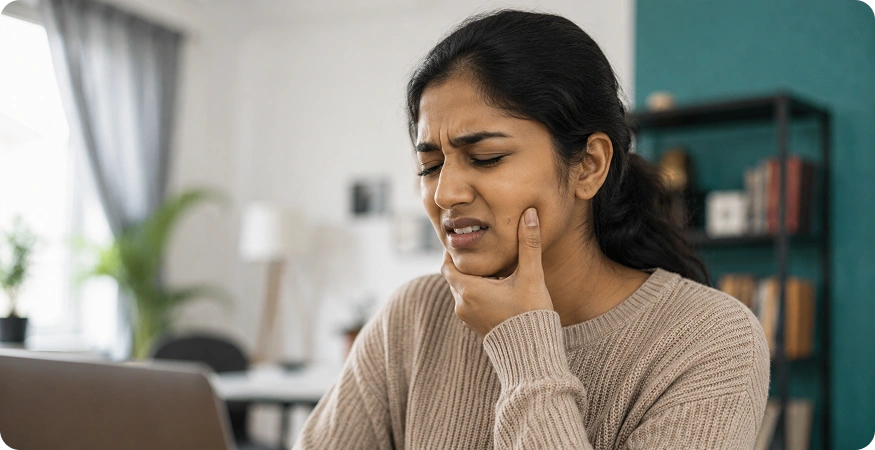
To understand why your jaw feels locked or heavy when you wake up, it helps to look at the temporomandibular joints (TMJ). These two complex joints. located on either side of your head just in front of your ears connect your lower jawbone (mandible) to your skull. They work alongside a delicate network of muscles, tendons, and cartilage discs to allow you to chew, speak, swallow, and yawn.
When everything is aligned, these joints glide effortlessly. However, several night-time factors can overload these structures while you sleep.
Sleep bruxism is one of the leading culprits behind morning jaw pain. While you sleep, your subconscious mind can exert hundreds of pounds of pressure per square inch across your upper and lower teeth.
1. Clenching forces the jaw muscles, primarily the masseter and temporalis into prolonged static contractions for hours.
2. Grinding shifts the joint back and forth forcefully, wearing down tooth enamel, irritating surrounding nerves, and fatiguing the muscle tissue.
When you wake up, your facial muscles are effectively experiencing “delayed onset muscle soreness,” leaving your jaw feeling fatigued, rigid, and restricted.
TMD refers to structural or functional problems within the TMJ complex itself. Within each joint lies a small cartilaginous disc that cushions movement. If this disc slips out of position (a condition called internal disc derangement), your jawbone can press directly against nerves and blood vessels.
When you lie still for hours during sleep, inflammation builds up around the misplaced disc, leading to intense stiffness and locking upon waking.
There is a profound connection between airway health and jaw position. If you suffer from obstructive sleep apnea (OSA) or upper airway resistance syndrome (UARS), your body naturally attempts to keep your breathing passage open during sleep.
To prevent the tongue from collapsing backward and blocking the throat, the brain unconsciously signals the jaw muscles to bite down, pull forward, or tighten. This reflex protects your breathing, but leaves your jaw muscles exhausted by dawn.
Sleeping on your stomach with your head turned sharply to one side puts asymmetric pressure directly on your mandible. Over 7 to 8 hours, this offset angle stretches the ligaments on one side of your face while compressing the joint on the other.
Similarly, using an improper pillow that tilts your neck unnaturally can throw off the neuromuscular balance between your cervical spine and your lower jaw.
Just like your knees, hips, or hands, your jaw joints are susceptible to structural arthritis:
1. Osteoarthritis: Wears down the protective cartilage over time, leading to bone-on-bone friction and severe morning stiffness that takes time to “warm up”.
2. Rheumatoid Arthritis: An autoimmune condition causing systemic inflammation in joint linings, frequently resulting in pronounced morning tightness in the jaw.
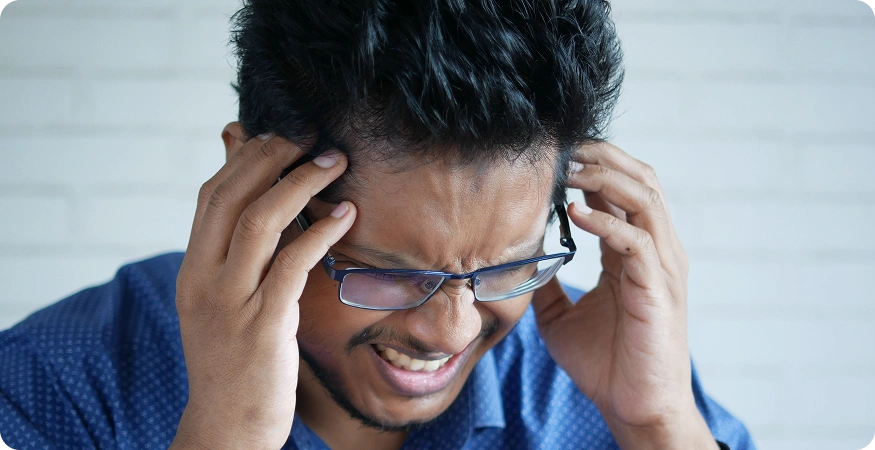
Daytime stress does not simply vanish when you close your eyes; it frequently manifests as elevated central nervous system arousal during sleep.
Chronic stress keeps your fight-or-flight response activated, causing involuntary muscular holding patterns across your neck, shoulders, and jaw throughout the night.
Morning jaw stiffness rarely travels alone. Depending on the underlying root cause, it is usually accompanied by a spectrum of secondary symptoms. Paying attention to these subtle clues can help pinpoint what is going on behind your smile.
Primary Signs in the Jaw and Mouth
1. Restricted Range of Motion: Difficulty opening your mouth wide enough to eat, yawn, or brush your teeth.
2. Clicking, Popping, or Grating Sounds: A distinct popping sensation when moving your lower jaw, or a crunchy sound (crepitus) caused by joint friction.
3. Jaw Locking: Your jaw temporarily gets “stuck” in an open or closed position, requiring gentle side-to-side wiggle movements to release.
4. Tooth Sensitivity and Wear: Waking up with sore, flattened, chipped, or overly sensitive teeth due to nocturnal friction.
Secondary Head and Facial Symptoms
1. Morning Tension Headaches: Pain that wraps around your forehead, temples, or the base of your skull like a tight band.
2. Ear-Related Discomfort: Deep earaches, a feeling of “fullness” or blockage in the ear canal, or ringing in the ears (tinnitus) without an active ear infection.
3. Facial Muscle Fatigue: A lingering ache in your cheeks, temples, or lower neck that feels like you’ve been chewing tough food for hours.
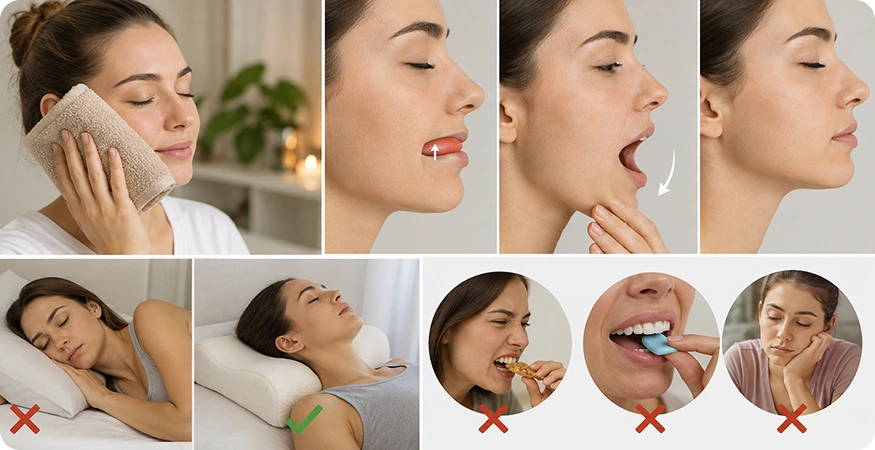
If you wake up with a tight, aching jaw tomorrow morning, do not force your mouth open. Forcing a restricted joint can cause micro-tears in the tissue or displace the articular disc further. Instead, try these gentle home measures to ease the acute tension.
Apply Moist Heat or Warm Compresses
Heat is a natural muscle relaxant that promotes localized circulation. Apply a warm, moist towel or a heating pad to the sides of your face and temples for 15 minutes upon waking. This helps dilate blood vessels, wash away accumulated lactic acid, and soothe spastic muscle tissue.
Practice Gentle Jaw Stretches
Once the muscles are warm, perform light range-of-motion exercises:
Adjust Your Sleeping Habits
While mild morning tightness caused by occasional stress often subsides with rest, persistent or worsening symptoms require evaluation by a qualified specialist. You should consult a medical or dental professional specializing in sleep and TMJ care if you experience:
Professional treatment may involve custom-designed oral appliances (such as neuromuscular nightguards or splints), trigger point therapy, physical therapy, or targeted sleep studies to address underlying airway obstructions.
You do not have to live with the daily burden of a locked jaw, morning headaches, and disrupted rest. At The Right Bite Sleep and TMJ Pain Care, we specialize in identifying and treating the true root causes of jaw stiffness, nocturnal bruxism, and TMJ dysfunction.
Our team utilizes advanced diagnostic technology to evaluate your joint alignment, muscle activity, and airway health. Rather than offering quick fixes, we design custom, non-invasive treatment plans tailored to your unique bite dynamics, helping you wake up feeling refreshed, pain-free, and fully restored.
Take the first step toward lasting relief. Contact us today to schedule your comprehensive consultation and discover what a healthy, comfortable morning feels like.
Not always, but it is one of the most common indicators. Morning jaw stiffness can also stem from temporary muscle fatigue due to stress, bad sleep posture, or sleep-disordered breathing. However, if the stiffness persists for weeks or is paired with clicking sounds, headaches, or pain, a evaluation for TMJ disorder is strongly recommended.
Store-bought mouthguards are generally not recommended for TMJ pain or bruxism. Because they are made of soft, pliable material and are not customized to your bite balance, they can actually trigger higher muscle activity and exacerbate night-time clenching.
Sleeping on your stomach forces your head to turn sharply to one side, applying asymmetric pressure directly onto your jaw joint for hours. Side sleeping without adequate neck support can also compress the joint. Back sleeping provides the most neutral alignment for your head, neck, and temporomandibular joints.
Clicking or popping usually occurs when the articular disc, the protective cartilage pad inside your joint, has slipped out of its proper position. As you open your mouth, the lower jaw bone snaps over the edge of the displaced disc, creating an audible pop or click.
You should consult a specialist if your jaw stiffness lasts longer than two weeks, causes severe pain, locks your mouth open or closed, or is accompanied by frequent morning headaches, ear pain, or difficulty chewing food. Early non-invasive intervention prevents long-term joint wear and chronic pain development.
Contact us
Our other blogs
Snoring and Dry Mouth: Causes, Connection and When to Seek Help
You wake up with a parched mouth, a sore throat and the feeling that your sleep did not do much good. Your partner, meanwhile, may

How to Improve Sleep: Simple Tips to Sleep Better and Wake Up Refreshed
Home > Blogs > How to Improve Sleep: Simple Tips to Sleep Better and Wake Up Refreshed How to Improve Sleep: Simple Tips to Sleep
Sports Mouth Guard vs Dental Mouth Guard: Key Differences
A mouthguard can look like a simple piece of plastic, but choosing the wrong type can leave your teeth, jaw, and dental work inadequately protected.
WhatsApp us