

Maxillary expansion is a procedure that gently widens the upper jaw (maxilla) to correct a narrow palate and create more space for the teeth.
Published on
Table of contents
You wake up with a dull headache, a tight jaw, and a strange feeling that your face has been working all night. You take a painkiller, get on with your day, and perhaps assume the headache is caused by stress, poor sleep, or too much screen time. But what if your teeth are part of the problem?
Tension-type headaches are extremely common, with the World Health Organization reporting that their average one-year prevalence is around 42% among adults. For some people, repeated teeth clenching or grinding may add another source of muscle tension around the jaw, temples, face, and neck.
So, can teeth grinding cause tension headaches? Yes, teeth grinding and clenching, known as bruxism, can contribute to headaches, particularly when the jaw muscles are repeatedly overworked. However, headaches can have many causes, so grinding should not automatically be assumed to be the only explanation.
Understanding the connection can help you recognize whether your morning headaches, jaw discomfort, or facial soreness may be linked to an underlying jaw or TMJ problem.
Bruxism is the repeated clenching, grinding, or rubbing of the teeth. It can happen while you are awake or during sleep.
Awake bruxism may involve unconsciously clenching your teeth while working, driving, concentrating, or dealing with stressful situations. You may not even realize you are doing it until your jaw starts feeling tired.
Sleep bruxism, on the other hand, happens while you are asleep. Some people discover it because a partner hears grinding sounds at night, while others only notice the consequences, such as worn teeth, jaw soreness, or headaches when they wake up.
Importantly, grinding does not always involve a loud, obvious sound. Sometimes the bigger issue is prolonged jaw clenching.
A 2025 systematic review and meta-analysis found that self-reported “possible” awake bruxism had a mean prevalence of 25.9% in the general population, although prevalence varied depending on how bruxism was assessed.
Your jaw is connected to a complex network of muscles and structures around your face, temples, and neck. When you repeatedly clench or grind your teeth, these muscles may remain active for long periods.
Think about holding a fist tightly closed for several minutes. Eventually, your hand and forearm would feel tired or sore. Your jaw muscles can experience a similar type of overload when they are repeatedly contracted. Several mechanisms may contribute to headache symptoms.
The muscles responsible for chewing, including the masseter and temporalis muscles, can become tense or fatigued when you frequently clench your teeth.
The temporalis muscle extends around the side of the head near the temples. When this area becomes sensitive or overloaded, discomfort may be felt around the temples or forehead.
This is one reason some people wake up with a headache that seems to have appeared without an obvious trigger.
Pain associated with jaw muscle tension does not necessarily stay directly around the jaw. You may feel discomfort around:
This can make it difficult to identify where the discomfort actually started. For example, imagine waking up with pressure around both temples and assuming you slept in an awkward position. Later, you notice that your jaw feels tired when eating breakfast. The two symptoms may be connected.
Stress is a commonly reported trigger for tension-type headaches, and it can also contribute to teeth clenching.
This creates a potential cycle: Stress → clenching → muscle tension → jaw discomfort → headache → more discomfort. This does not mean every stress-related headache is caused by bruxism. Instead, stress may act as a trigger for both behaviors at the same time.
The temporomandibular joints, or TMJs, are located on either side of your head, just in front of your ears. They connect your lower jaw to your skull and allow you to talk, chew, and open your mouth.
Repeated clenching and grinding can place additional strain on the jaw muscles and TMJ structures. TMJ disorders may involve jaw pain, facial pain, difficulty chewing, ear-area discomfort, and headaches.
That means a headache may sometimes be part of a broader jaw-related problem rather than an isolated headache condition.
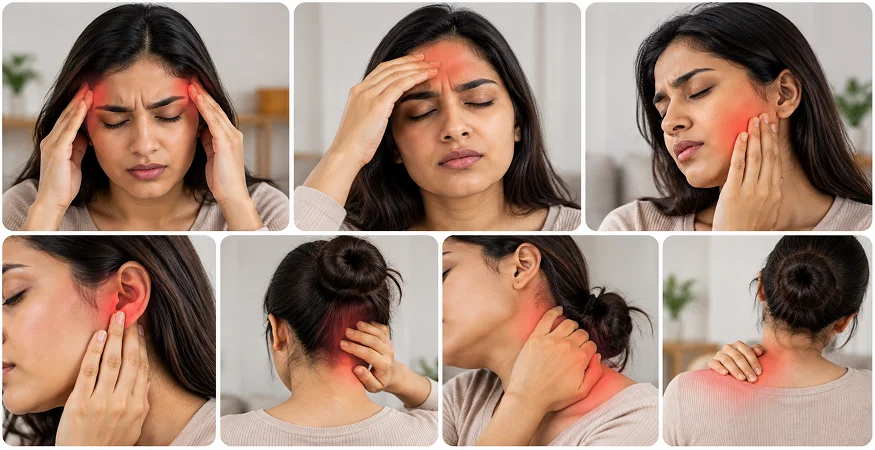
There is no single headache pattern that proves teeth grinding is responsible. However, some symptoms may provide useful clues. A headache associated with jaw tension may feel like:
Tension-type headaches are commonly described as a feeling of pressure or tightness around the head rather than the throbbing sensation often associated with migraine.
However, headache symptoms overlap across many conditions. A proper evaluation is important if headaches are frequent, changing or interfering with everyday activities.
Do you regularly experience headaches alongside any of these symptoms?
Morning Jaw Pain or Stiffness
If your jaw feels tired, tight, or sore when you wake up, nighttime clenching or grinding could be worth investigating.
Tooth Sensitivity or Wear
Repeated grinding can contribute to flattened, chipped, or fractured teeth, worn enamel, and tooth sensitivity.
Jaw Clicking or Popping
Clicking or popping around the jaw does not automatically mean you have a serious TMJ disorder. However, if these sounds occur alongside pain, restricted movement, or headaches, they are worth discussing with a dental or TMJ professional.
Ear-Area Discomfort
Jaw-related problems can sometimes feel like an earache even when there is no underlying ear problem.
Neck and Shoulder Tension
The jaw, head, and neck work as part of a connected muscular system. If your jaw is repeatedly tense, you may also notice tightness elsewhere.
Your Partner Notices Grinding at Night
Some people are completely unaware that they grind their teeth while sleeping. A partner who notices repeated grinding sounds can provide an important clue.
Bruxism does not have one single cause. It may involve a combination of behavioral, psychological, sleep-related, medical, and genetic factors. Common contributors can include:
Stress and Emotional Tension
Work pressure, anxiety, frustration, and everyday stress may encourage unconscious clenching, particularly during concentration or emotionally demanding situations.
Sleep-Related Factors
Sleep bruxism is a sleep-related movement disorder and can occur alongside other sleep problems. Some people with sleep bruxism may also have snoring or pauses in breathing during sleep.
Caffeine, Alcohol, and Tobacco
Certain substances may increase the likelihood of bruxism in some people. Mayo Clinic identifies caffeine, alcohol, and tobacco as potential risk factors.
Certain Medicines and Health Conditions
Some medicines and medical conditions can be associated with bruxism. This is one reason it is important not to treat teeth grinding as a standalone issue without considering the wider picture.

You do not necessarily need to hear yourself grinding your teeth to have bruxism. A dental or TMJ assessment may look for signs such as
Your clinician may also ask when your symptoms occur. For example, do you wake up with pain? Does your jaw hurt after a stressful workday? Do headaches appear after prolonged concentration?
These details can help identify patterns. In some cases, if sleep-related problems are suspected, further assessment by a sleep specialist may be appropriate.
Treatment depends on what is causing the grinding, jaw pain or headache. A professional may recommend approaches such as:
Addressing Daytime Clenching
If you regularly clench your jaw while working or concentrating, becoming aware of the habit is an important first step. Keeping the jaw relaxed rather than constantly holding the teeth together can reduce unnecessary muscle activity.
Managing Contributing Stress
Stress management, relaxation techniques, and behavioral approaches may help when stress contributes to daytime clenching or headaches.
Protecting the Teeth
Depending on your individual situation, a dental professional may recommend an appropriate oral appliance to help protect the teeth and manage certain symptoms.
Addressing Underlying Sleep Problems
If sleep bruxism occurs alongside a sleep-related breathing disorder or another sleep problem, addressing that condition may be part of the overall approach.
Evaluating TMJ and Jaw Muscle Problems
When headaches occur alongside jaw pain, restricted movement, facial discomfort, or other TMJ symptoms, addressing the underlying jaw problem may be more important than simply treating the headache itself.
Occasional headaches do not necessarily indicate a jaw disorder. But persistent or recurring headaches deserve attention, especially when they occur with jaw symptoms.
Consider seeking professional assessment if you experience:
And remember: a sudden, extremely severe headache or a headache accompanied by symptoms such as weakness, confusion, seizures, vision problems, or difficulty speaking requires urgent medical attention.
Teeth grinding and clenching can place repeated strain on the jaw muscles and may contribute to tension-type headaches in some people. Research also suggests an association between awake bruxism and tension-type headaches, although the evidence is not strong enough to say that bruxism causes every tension headache.
One systematic review found an association between awake bruxism and tension-type headaches, while noting limitations in the available evidence.
The key is to look beyond the headache itself. If your headache comes with jaw tightness, morning facial soreness, tooth wear, clicking, chewing discomfort, or neck tension, your jaw may deserve closer attention.

A recurring headache may seem like a problem that starts in your head, but in some cases, the jaw may be part of the picture. Repeated clenching and grinding can overload the muscles involved in chewing and may contribute to jaw discomfort and tension-type headache symptoms.
Instead of repeatedly masking the pain, consider finding out what may be triggering it. The Right Bite Sleep and TMJ Pain Care™ focuses on non-surgical care for TMJ disorders, headaches, migraines, and sleep-related breathing concerns.
If you are experiencing recurring headaches alongside jaw pain, teeth grinding, or other TMJ symptoms, book a consultation with us to discuss your symptoms and explore an appropriate, personalized approach to care.
Frequent teeth grinding or clenching may contribute to recurring headaches in some people, particularly when jaw muscles remain tense or overloaded. However, daily headaches can have several possible causes and should be professionally evaluated.
Look for accompanying signs such as morning jaw soreness, tooth sensitivity, worn teeth, jaw stiffness, temple pain, facial discomfort, or a partner noticing grinding during sleep. These symptoms do not confirm bruxism but can indicate that an assessment may be useful.
Yes. The temporalis muscle is involved in chewing and is located around the temple region. Repeated clenching or grinding can contribute to muscle fatigue and discomfort around the temples.
TMJ disorders can be associated with headaches, jaw pain, facial pain and neck discomfort. If headaches occur together with jaw symptoms, evaluating the TMJ and surrounding muscles may help identify contributing factors.
Yes, particularly if the headaches are recurring or occur alongside jaw pain, tooth wear, sensitivity, clicking, or difficulty opening your mouth. A dental or TMJ professional can assess the jaw, teeth and surrounding muscles and determine whether further evaluation is appropriate.
Contact us
Our other blogs
Maxillary expansion is a procedure that gently widens the upper jaw (maxilla) to correct a narrow palate and create more space for the teeth.
Can Gums Grow Back After Receding? Causes and Treatment Options
Gum recession is common, and it’s easy to miss early on. Some people notice their teeth look a little longer than they used to. Others
Mouth Breathing at Night: Effects, Causes & Symptoms
Waking up with a painfully dry mouth, a scratchy throat, bad breath, or the feeling that you barely slept can be frustrating, especially when you
WhatsApp us