Snoring and Dry Mouth: Causes, Connection and When to Seek Help
You wake up with a parched mouth, a sore throat and the feeling that your sleep did not do much good. Your partner, meanwhile, may
Published on
Table of contents
Sleep apnea isn’t just about how long you sleep. You can spend seven or eight hours in bed and still wake up tired and foggy, then drag yourself through the day.
If you’re searching for how to improve sleep apnea, start with why your breathing keeps getting interrupted at night. The right treatment depends on how severe it is, your airway anatomy, your jaw position, your general health and how well you cope with each option.
CPAP works for some people. Others do better with a professionally fitted oral sleep appliance. Small changes help too, like how you sleep or sorting out a blocked nose.
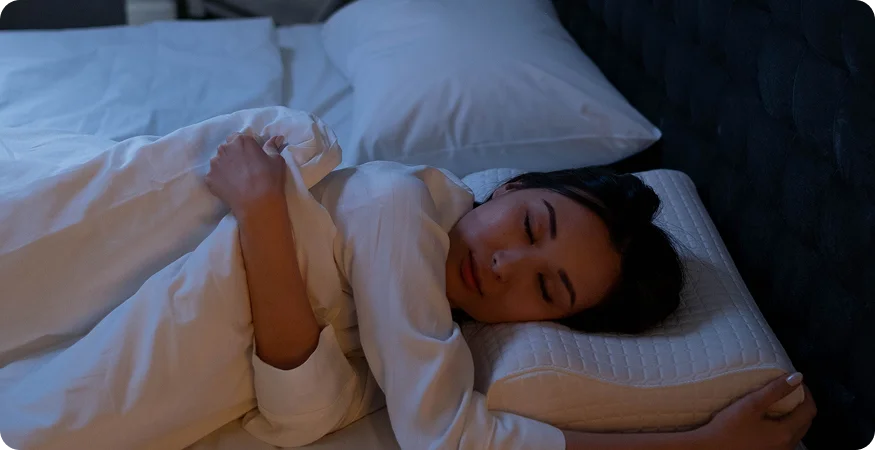
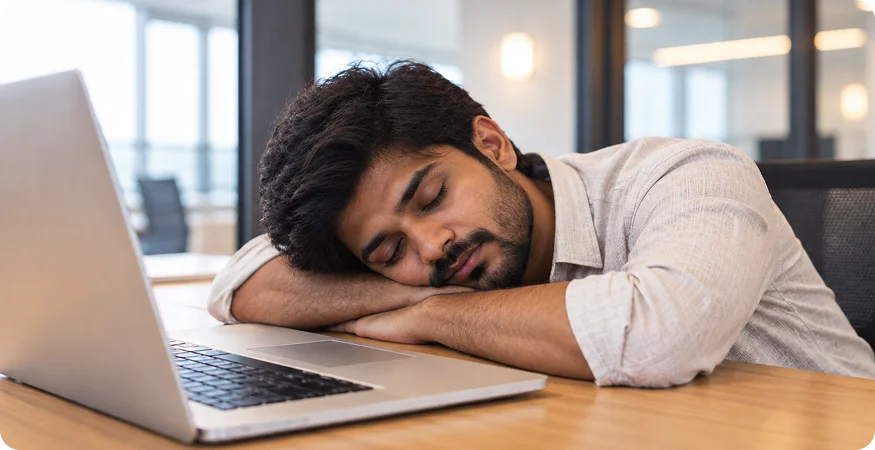
If you wake up feeling tired, groggy or feel that despite an 8 hour sleep, you don’t feel well rested, you have brain fog, you have daytime sleepiness / exhaustion especially around afternoon time then you are definitely not alone. Sleep Apnea affects millions of people worldwide. When most people search how to improve sleep apnea, they land up about reading about CPAP or BiPAP machines. While these machines can prove to be absolute lifesavers for many people, the patient compliance and comfort seems to be low especially due to a mask strapped to the face while sleeping, which pushes air under pressure through these masks into the patient’s upper airway.
Hours in bed and quality of sleep are two different things. With obstructive sleep apnea, your breathing keeps stopping and starting, and that wrecks the deeper stages of sleep.
You might not remember waking up at all. You’ll still feel flat the next morning.
Signs that often show up with sleep apnea:
If you notice these regularly, get a proper sleep assessment.
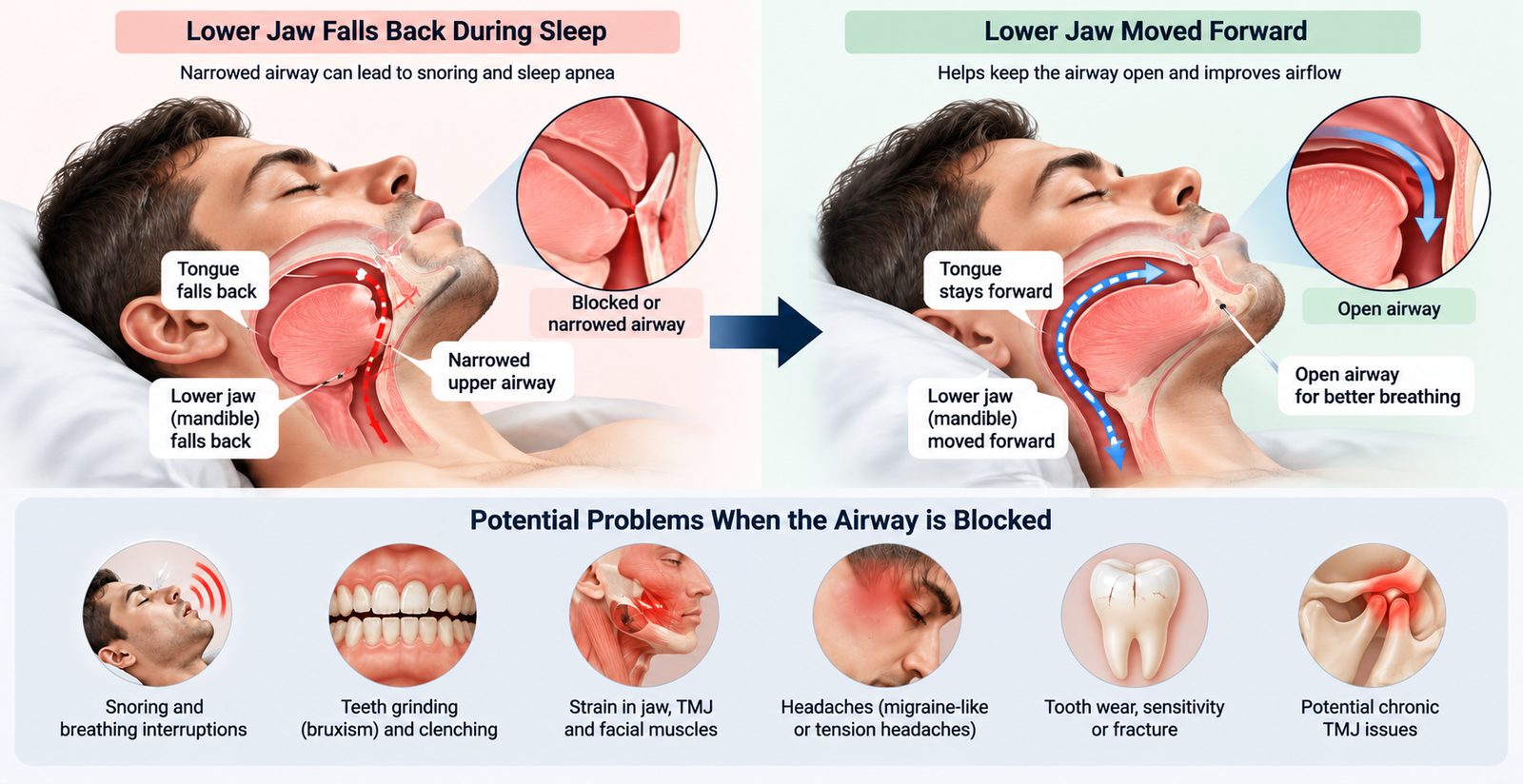
Interestingly, the secret to a better sleep might lie in your lower jaw structure and position while sleeping. When we sleep, our lower jaw (the mandible) and our tongue (which is attached to our lower jaw) can fall back thereby narrowing or obstructing our throat (upper airway). As a result, this creates an obstruction to airflow while we are unconscious in our dreamland. This obstruction to airflow can create a lot of issues in the body including our jaws and TMJs.
In many cases such patients suffer from sleep bruxism (teeth grinding while sleeping) and / or sleep clenching because the brain goes into survival mode and tells the lower jaw to move forward in order to open up the airway, which can, overtime, create a lot of strain in the TMJ, jaw muscles and facial muscles and if left unchecked, can create a potential chronic TMJ issue, jaw muscle pain, facial muscle pain, headaches, pain which might mimic a migraine or tension headache, teeth sensitivity due to enamel wear and tear, potential teeth fracture, potential damage to existing crowns, bridges and dental implants etc.
Your lower jaw, tongue and airway all work together. Shift the jaw and you change how much room the air has to get through. That’s also why breathing trouble at night often comes with teeth grinding, a tight jaw, facial pain or headaches when you wake up.
Still, the jaw is only one piece. Body weight, a blocked nose, where your tongue sits, the soft tissue in your throat, your sleeping position and your own airway shape all play a part.
There’s no single answer. It depends on you. Here’s what people commonly use.
CPAP stands for Continuous Positive Airway Pressure. A machine pushes pressurised air through a mask so your airway doesn’t collapse while you sleep.
Used consistently, it can work very well, especially if your apnea is moderate or severe. The catch is that plenty of people struggle with it. The mask feels awkward, your mouth dries out, the pressure bothers you, or you just can’t sleep with all that gear.
Some people block up more when they lie on their back. If that’s you, sleeping on your side may cut down the interruptions.
It won’t be enough for everyone, though.
Extra weight around the neck and airway can narrow the space you breathe through. Losing it gradually may ease the severity of obstructive sleep apnea.
But thin people get sleep apnea too, so weight isn’t the whole story.
Alcohol relaxes the muscles in your throat. In some people that makes snoring worse and lets the airway collapse more easily.
Cutting back close to bedtime is a simple thing to try.
For some patients, an oral sleep appliance is another route. It’s most useful when CPAP is hard to put up with, or when you’re a good fit for this kind of treatment.
To handle this, there is a treatment modality known as an oral sleep appliance. These appliances, if made properly, by using advance technology such as ULF-TENS therapy to relax the facial and jaw muscles, surface muscle electromyography (sEMG) and a 3D jaw tracker to accurately map and record the best possible and most comfortable jaw position for that patient, can dramatically change the quality of life for that patient and improve the sleep quality and thereby improving overall health of the patient. Remember, in dental science, there is no space for guess work, accuracy to the fraction of a millimetre matters!
You wear it in your mouth while you sleep. It holds your lower jaw in a position that keeps more space open in your upper airway.
A well-made one accounts for your bite, how your jaw moves, the state of your TMJ, your dental health and whether you can handle having your jaw held forward. So don’t think of it as a drugstore mouthguard. It isn’t one.
Instead of forcing pressurized air down your throat, these custom-made appliances gently reposition your lower jaw comfortably forward, thereby helping in keeping the airway open naturally while you sleep. However, there is a huge difference between how these oral appliances are made. These appliances are not to be confused with the standard ‘night guard’. A night guard (hard or soft) is like a shield for teeth and is made using a basic, static mold of your teeth. It sits between the upper and lower teeth and protects teeth from wear and tear during bruxism, but leaves your jaw where it is. It takes the beating and protects teeth from attrition, and is generally given to patients who only have mild teeth sensitivity due to teeth bruxism, but it ignores your TMJ, jaw and facial muscles. There have been reports in some patients, a soft night guard aggravated the TMJ pain, jaw pain and facial pain. The gap between the two matters a lot.
A night guard protects your teeth from grinding and clenching. That’s its whole job. An oral sleep appliance does something else, because it changes where your lower jaw sits so your airway stays supported.
Since they do different things, don’t assume a regular night guard treats sleep apnea. It doesn’t.
Some adults with obstructive sleep apnea may be good candidates, depending on their sleep assessment, dental condition and jaw health.
It’s worth considering if you:
Quieter snoring shouldn’t be the only goal. What you really want is better breathing at night, with a jaw, teeth and muscles that still feel fine.
Pulling the lower jaw forward changes the load on your teeth, your muscles and your temporomandibular joints. So before treatment, it helps to check:
Follow-up matters just as much. Your jaw, bite and muscles can react differently as time goes on.
Feeling better is a good sign. It doesn’t prove your sleep apnea is under control, though.
You could snore less and still stop breathing now and then through the night. Depending on your plan, a follow-up sleep test may be needed to see if those interruptions have dropped enough.
So good management means two things. You’re comfortable, and the numbers show real improvement.
By fabricating an oral sleep appliance using precise and accurate data, your sleep issues can be managed at the same time keeping your TMJ, jaw muscles and facial muscles and upper airway happy and tension free. If you are battling with similar issues then do not ignore it and act now before things get out of hand and it starts affecting your quality of life. Remember, you are not just buying an appliance, you are also investing in your own improved quality of life, healthy breathing and peaceful sleep.
When you’re working out how to improve sleep apnea, find what’s blocking your airway first. Then pick a treatment you can actually stick with.
CPAP might be the best fit for you. A custom oral sleep appliance might suit someone else. Plenty of people also tackle weight, sleeping position, alcohol or nasal breathing alongside their main treatment.
Sleep apnea should not be ignored, particularly when symptoms such as loud snoring, daytime sleepiness, brain fog, morning headaches, teeth grinding or jaw discomfort are present. These signs may indicate that your sleep quality and breathing are being affected more than you realise. The right treatment should not only help you sleep more comfortably but also support healthy breathing, reduce strain on the jaw and TMJ, and improve how rested you feel during the day.
At Right Bite Sleep & TMJ Pain Care, the focus is on understanding the connection between the airway, jaw position, TMJ and sleep to create a personalised plan for better breathing, better sleep and improved daily comfort.
In some people, symptoms can substantially improve or resolve with appropriate treatment or changes in contributing factors. However, many people require ongoing management.
Yes, side sleeping can help some people, particularly those whose apnea is worse when sleeping on their back.
CPAP generally provides stronger control of breathing abnormalities, but oral appliances can be an appropriate alternative for selected patients, particularly when CPAP is not tolerated or preferred.
Weight management can improve sleep apnea in people for whom excess weight contributes to airway obstruction, although it does not guarantee that OSA will disappear.
Yes. Some people may have few noticeable symptoms despite having sleep apnea. A proper diagnosis and treatment plan are important because untreated OSA can have significant health consequences.
Contact us
Our other blogs
Snoring and Dry Mouth: Causes, Connection and When to Seek Help
You wake up with a parched mouth, a sore throat and the feeling that your sleep did not do much good. Your partner, meanwhile, may
How to Improve Sleep: Simple Tips to Sleep Better and Wake Up Refreshed
You can spend eight hours in bed and still wake up feeling like you have barely slept. Your alarm rings, you hit snooze, then finally
Sports Mouth Guard vs Dental Mouth Guard: Key Differences
A mouthguard can look like a simple piece of plastic, but choosing the wrong type can leave your teeth, jaw, and dental work inadequately protected.
WhatsApp us